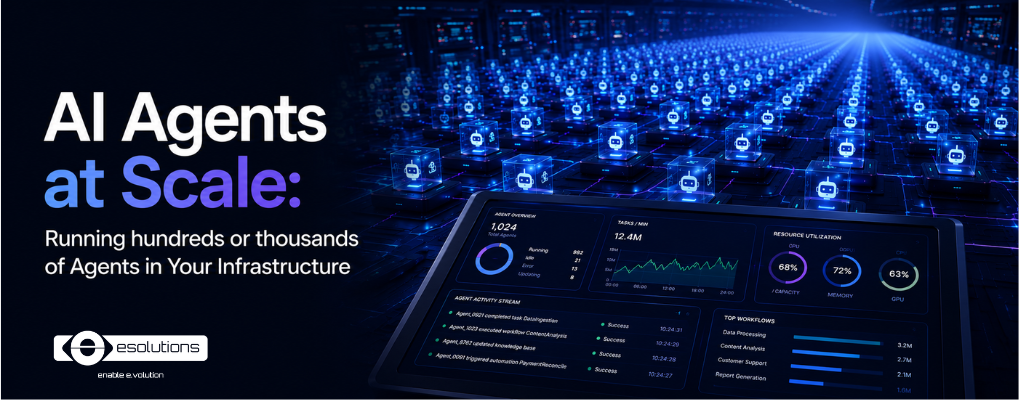
It was natural, at first, to treat AI agents like smart chatbots. In pilot deployments, that was enough: one task per agent, with a human close by to review outputs and correct mistakes. But pilot assumptions don’t survive production scale. The moment five agents become five hundred, manual oversight stops working.
An agent workforce needs the same things a human workforce needs: defined roles, a chain of command, real-time supervision, and someone who owns the outcome. Organizations that skip these four layers discover the hard way that agents at scale behave like employees without job descriptions, reporting lines, or performance reviews.
Agents have crossed the threshold from tools to actors, though most organizations have not yet named it. A tool waits for instruction. An actor perceives its environment, decides, and takes action autonomously, persistently, and with delegated authority over systems of record. When a chatbot gives an incorrect answer, the person who deployed it is accountable. When an agent reroutes a shipment, approves a transaction, or merges a pull request without human review, accountability is ambiguous. Was it the model, the configuration, the data, or the decision to delegate? Most governance frameworks cannot answer that question consistently.
What makes this urgent is the speed of the shift. According to IBM Institute for Business Value research, 55% of organizations are already developing or deploying an agentic AI operating model. Businesses expect agentic AI to deliver a 45% improvement in operational efficiency by the end of 2027. Yet 82% of C-suite executives say functional silos block the value autonomy is designed to deliver. The intent is there. The infrastructure lags behind.
Scaling to hundreds or thousands of agents is less about model power and more about four structural choices.
Standardized agent roles. A general-purpose agent with broad system access and a vague mandate is ungovernable at scale. Specialization makes behavior auditable. A security reviewer agent that only flags exploitable vulnerabilities and is explicitly instructed to ignore theoretical risks in unchanged code produces output that a human can reason about. A code quality agent with a defined scope of what to check and what to ignore generates actionable rather than noisy findings. Each agent's scope of action should be intelligible from its role definition alone. When something goes wrong, the question shifts from "what did the AI do" to "which agent, with which role, under which constraints."
Control plane discipline. At scale, model providers go down when rate limits are hit. A single expensive model burning tokens on a trivial task costs real money. The infrastructure layer needs circuit breakers that detect provider failures and route to fallback models without human intervention, risk-tiered routing that assigns lightweight models to small changes and reserves reasoning-heavy models for high-impact decisions, and timeouts that prevent one slow agent from blocking the entire workflow. These are platform engineering problems. The control plane is where the workforce model becomes operational.
Runtime governance. Static permissions and post-hoc audits fail at machine speed. An agent can execute hundreds of actions per minute. Governance must be real-time: role-based access controls that enforce data boundaries per agent and per workspace, guardrail agents that intercept high-risk actions before they reach production systems, and behavioral baselines with confidence thresholds that escalate to human review only when an action exceeds the agent's normal operating envelope. This is the shift from Human-in-the-Loop, where a person approves every action, to Human-on-the-Loop, where humans set boundaries and intervene at thresholds. Without it, governance exists only on paper.
Organizational ownership. Every agent needs a business owner, a documented risk profile, and decision boundaries that define what it can and cannot do. Without this, agents become organizational orphans, capable of acting but owned by no one. The coordination layer compounds this risk. When multiple agents respond to the same signal independently, each doing what its logic says is correct, the collective outcome can amplify rather than resolve the problem. No single team claims responsibility for the swarm's behavior because no single team was assigned to own it. Ownership is the mechanism that makes autonomy survivable.
The above structural choices show up in practical patterns that organizations are already running in their own infrastructure.
Code review at scale is the most common pattern. Instead of a single monolithic agent reviewing every pull request, teams deploy multiple specialized reviewers (a security reviewer, a code quality reviewer, a documentation reviewer, a compliance reviewer), each with a tightly scoped prompt that defines what to flag and what to ignore. A coordinator agent deduplicates findings, judges severity, and routes reviews by risk tier. Trivial changes get a lightweight pass. Security-sensitive files trigger a full review. The architecture depends on role design and routing discipline, not model sophistication.
Security scanning with an OSV scanner follows the same architecture. Static analysis tools catch known patterns. They miss security design flaws: a new public-facing endpoint introduced without authorization, a single sign-on flow modified, a cryptographic secret compiled into a binary. Multi-agent security review, where specialized agents analyze pull requests with the context of an experienced security engineer, catches what SAST cannot. The same workforce architecture applies: specialized roles, defined scope, coordinated output.
On-demand agent tasks on git repositories complete the set. A bug is filed in Jira. An agent is triggered. It analyzes the ticket, maps it to the relevant codebase, proposes or applies a fix, and reports the result. This is an agent executing work within the infrastructure, with access to tools, under defined constraints, and with audit trails that trace every action to a specific agent identity and role.
The gap between running five agents and five hundred sits in the operating model. McKinsey research shows that the length of tasks AI can reliably complete has doubled approximately every four months since 2024. Within two years, AI systems could complete four days' worth of work without supervision. The capability curve is steep. The operating model curve is flat. Most organizations have not built the control structures that make that capability governable at scale.
Platforms designed for this workforce model provide the missing layer. eSolutions' Multi-Agent Systems enable specialized agent roles with defined scopes, each deployed against specific tasks with clear boundaries. The Alteus Admin Console serves as the control plane: role-based access control that enforces data boundaries per workspace, project-level data protection, and a vendor-agnostic architecture that allows organizations to mix and match AI providers without lock-in. MCP-based tool calling gives agents structured access to external systems (APIs, linters, ticketing platforms), so they operate as actors within the infrastructure rather than as conversational interfaces layered on top. Background Agents handle long-running asynchronous tasks without constant human monitoring, from code refactoring to audit sweeps across repositories.
Each pillar maps to a specific capability in the platform. Standardized roles map to Multi-Agent Systems with per-agent scope definitions. Control plane discipline maps to the Alteus Admin Console with its centralized oversight, vendor-agnostic routing, and model flexibility. Runtime governance maps to RBAC, data protection controls, and MCP-based tool governance that constrains what each agent can access and execute. Organizational ownership maps to the centralized administration model, where every agent deployment is tied to a department, a workspace, and an accountable owner.
Agents can do the work. Organizations are already betting they can. The question is whether the organization can govern them once they are doing it, at machine speed, across hundreds of repositories, under conditions where a single misconfigured agent can cascade into operational risk before anyone notices. That is an operating model problem, not a model problem. Most enterprises have yet to name it.


 RO
RO
 EN
EN


