
The choice between buying or building software for your company’s operational needs is often influenced both by leadership and by company goals. Strategic software implementation drives improved efficiency, productivity, and market competitiveness for businesses, so this choice is one that leadership should consider well. Let’s analyze how the buying vs building paradigm changed in time, as well as after AI.
When the internet era began, businesses found it essential to develop innovative software for the well-functioning of their internal operations. With few specialized tools available on the market, they built these solutions themselves, which eventually led them to offer their proprietary software to other businesses with identical requirements. They realized that developing custom tools and systems would provide a competitive edge, ensure a perfect fit with the company’s unique processes, and foster internal expertise. The focus was on leveraging the skills and creativity of existing teams, investing in long-term capability building, and maintaining full control over the development process and the end solution. While this often resulted in highly tailored solutions, it also required significant time, resources, and ongoing maintenance.
As the software industry matured, a more robust ecosystem of commercial off-the-shelf (COTS) solutions began to emerge, leading to a significant strategic shift towards 'buying' ready-made software. This approach was driven by the desire for speed, efficiency, and access to the latest technologies without the lengthy development cycles. By adopting ready-made products, the organization could quickly implement proven solutions, reduce development risks, and free up resources to focus on core business activities. This shift also reflected a recognition that many business needs could be met with industry-standard tools, allowing the company to stay agile and competitive in a rapidly changing market.
Since more providers and more startups provided very specific tools, it was easier to find the one that was right for your business and simply customize it, since more often than not, they also allowed for various customization options.
And now? With AI, you could say that another switch in mindset and paradigm is taking place, towards building custom solutions again.
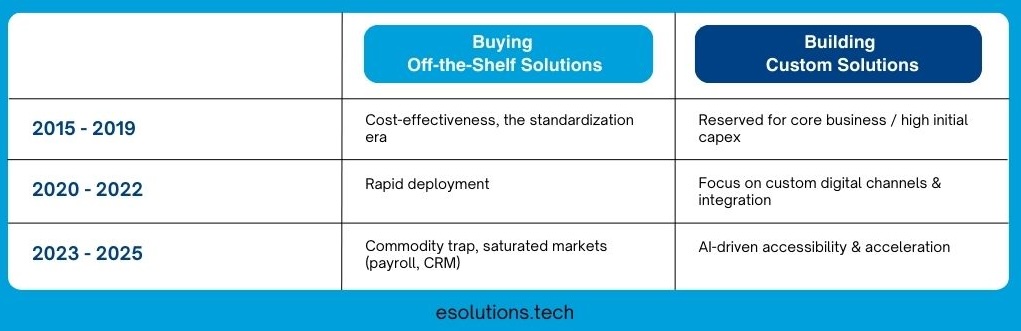
Generative AI tools and intelligent development environments are making it faster, cheaper, and more accessible for companies to develop solutions or to significantly customize and extend existing ones. This isn't necessarily a return to building every component from scratch, but rather a strategic re-emphasis on custom development where unique AI capabilities, data insights, or highly specialized workflows are critical differentiators.
The “build” of today is often an AI-augmented, data-centric, and highly strategic endeavor, blurring the lines between pure custom development and intelligent integration.
Organizations often discovered that owning software could generate long-term expenses that matched or even exceeded the cost of purchased platforms. Custom development demands continuous investment in updates, security patches, performance monitoring, comprehensive documentation, and a steady supply of skilled engineers for maintenance and evolution. These ongoing needs can transform an initially attractive internal project into a significant, long-term financial and resource obligation, often leading to technical debt and opportunity costs.
Purchased products have their own costs, yet the comparison is not always as simple as it appears. While they might reduce initial development overhead, costs accumulate through licensing fees, subscription models, integration efforts with existing systems, vendor lock-in, and the potential need for costly customizations or workarounds to fit unique business processes. The trade-off has traditionally been between the high, ongoing maintenance of a custom build versus the recurring, often less flexible costs of a commercial product.
Now you can have full customization and full control over security and data, while also benefiting from lower costs and less resource allocation, thanks to AI.
AI is democratizing and accelerating the “build” process, allowing organizations to achieve a new sweet spot.
By leveraging generative AI for code creation, AI-powered low-code/no-code platforms, and intelligent automation for testing and maintenance, companies can develop highly customized solutions with significantly reduced development time and resource allocation. This means gaining full control over security, data, and features, traditionally the domain of expensive custom builds, while simultaneously benefiting from lower operational costs and a more efficient use of engineering talent. AI is enabling a future where the competitive advantages of bespoke software are attainable without the prohibitive TCO of the past.
By leveraging generative AI for code creation, AI-powered low-code/no-code platforms, and intelligent automation for testing and maintenance, companies can develop highly customized solutions with significantly reduced development time and resource allocation. This approach not only grants full control over security, data, and features, traditionally the domain of expensive custom builds, but also extends its benefits across the entire software lifecycle, which is crucial for long-term TCO.
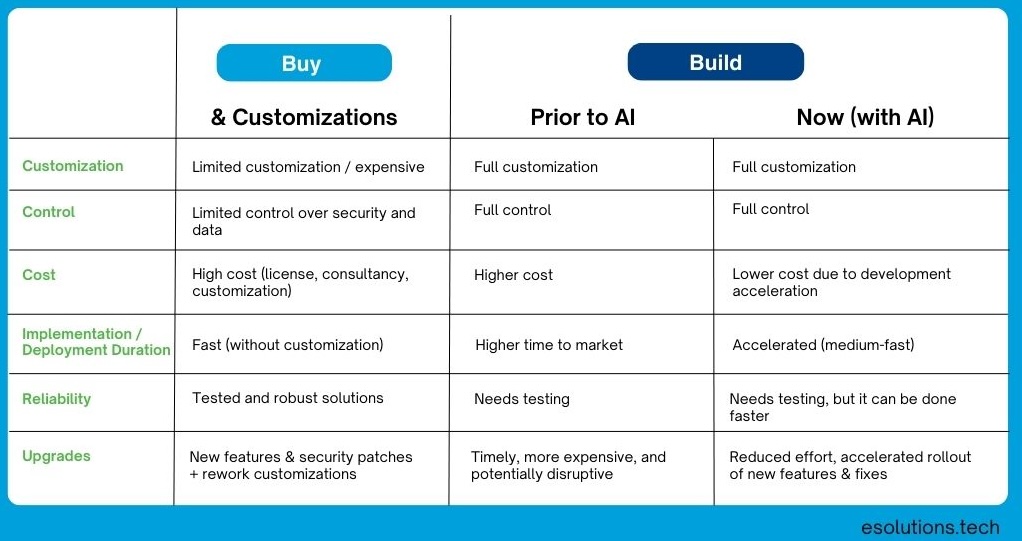
The traditional “build vs. buy” dilemma, long a strategic balancing act between unique competitive advantage and perceived cost savings, has been fundamentally reshaped by AI. Its impact dissolves the constraints that once pushed organizations towards off-the-shelf solutions, making the promise of full customization, granular control over data and security, and a truly optimized user experience attainable.
AI allows businesses to build their distinct competitive edge. The future of software shouldn’t be about choosing between pre-packaged limitations or costly custom builds. It should be about intelligently creating precisely what's needed, when it's needed.
***
Do you prefer buying off-the-shelf solutions or building custom software? Let’s get in touch.


 RO
RO
 EN
EN


