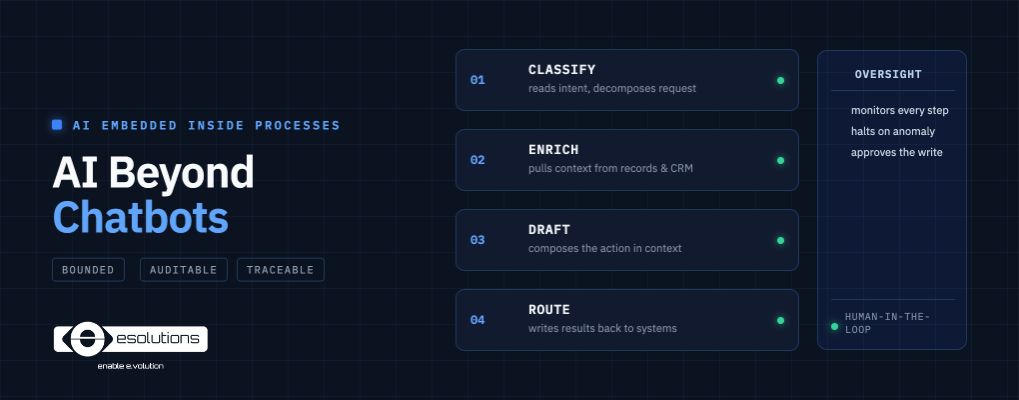
In the past years, the public face of artificial intelligence has been the chat window. You open a box, you type a question, and a capable assistant types back. It has been a genuine breakthrough, and it has reshaped how millions of people think about what software can do. But there is a downside to it: it frames AI as something you visit, a destination you navigate to, ask for help, and then leave. The next phase of this technology looks different. Instead of being a place you go, it is becoming a property of the tools you already use, woven invisibly into the documents, spreadsheets, codebases, and workflows where the actual work happens.
This shift matters because the chatbot model carries a hidden tax. Every time you leave your task to consult an assistant, you must explain your context: what you're working on, what you've already tried, what the constraints are. The conversation is smart, but it's stranded on an island, disconnected from the live state of your work.
The most telling examples aren’t futuristic. An email assistant that sees the thread you’re in and drafts the next useful response in context is fundamentally different from one you have to explain the situation to. A spreadsheet that can be asked, in plain language, to restructure a model and then actually does it. A writing tool that edits alongside you rather than handing back a block of text to copy and paste. In each case, the interface recedes, and the capability remains.
Strip away the marketing and "agentic" means something specific: the model doesn't just answer, it acts - it reads systems, makes decisions, and writes results back. The confusion comes from how much freedom it's given to act. The headline-grabbing version, where AI autonomously plans and pursues open-ended goals, remains an active research problem and is largely absent from the business processes where most AI is being deployed.
For enterprises, especially in regulated sectors, AI adoption depends on control, accountability, and measurable quality. So, the way forward is AI embedded in the steps of a purposeful workflow: people design the sequence, and the AI executes each step with reasoning, context, and tools. Less cinematic but it can be audited, scaled, and trusted with a regulated process
No system built on a language model is deterministic. The same input can produce different phrasings, different orderings, and occasionally different judgments. What a well-designed workflow guarantees is not identical output but bounded behavior: the model cannot act outside the steps, tools, and thresholds the team defined. The variability lives inside the step; the shape of the process does not move.
Inside the boundary, three things happen:
None of this is possible with rule-based automation: a script cannot read an ambiguous email, remember what it learned two steps ago, nor decide which system to update.
These three capabilities are what a single agent contributes to one step. A real process chains several together: a classifier hands to an enricher, the enricher to a drafter, the drafter to a router - each a narrow agent that does one thing well, passing structured output to the next. The orchestration between them is designed by people; the judgment inside each is the model's. Specialized sub-agents fail less often than one generalist trying to do everything, and when they do fail, the failure is easy to trace to a single step.
Teams getting useful work out of agentic systems tend to follow a similar playbook:
From 2 August 2026, the EU AI Act requires exactly this for high-risk systems: automatic event logs, retained for at least six months, capable of reconstructing how the system behaved. Regulation is codifying what better deployments were already doing.
The clearest public evidence comes from healthcare. Between late 2023 and the end of 2024, more than 7,000 physicians at Kaiser Permanente - The Permanente Medical Group used an ambient AI scribe across roughly 2.5 million patient visits. The system listens to the consultation, drafts the clinical note, and hands it to the physician, who edits and signs it before anything enters the record. A follow-up analysis published in NEJM Catalyst estimated the tool saved over 15,700 hours of documentation time in its first year - the equivalent of nearly 1,800 working days returned to patient care.
Note what the deployment is not. The AI does not diagnose, does not recommend treatment, and does not write to the record on its own. It executes one narrow, high-volume step inside a process physicians still own - and that is precisely why it scaled to millions of encounters while most enterprise pilots never left the lab.
Kaiser Permanente proved the pattern at scale. The same problem exists in every clinic. Electronic medical records are the system of record for every patient interaction, which makes them both indispensable and, for the physicians who use them, a major source of administrative drag. Surveys indicate that a substantial share of a typical physician's working day is spent on administrative tasks rather than patient care.
We built Alteus Medical on exactly this pattern - purpose-built agents integrated with the EMR. Each agent has a narrow role, operates at a defined point in the clinical workflow, and produces a clear output.
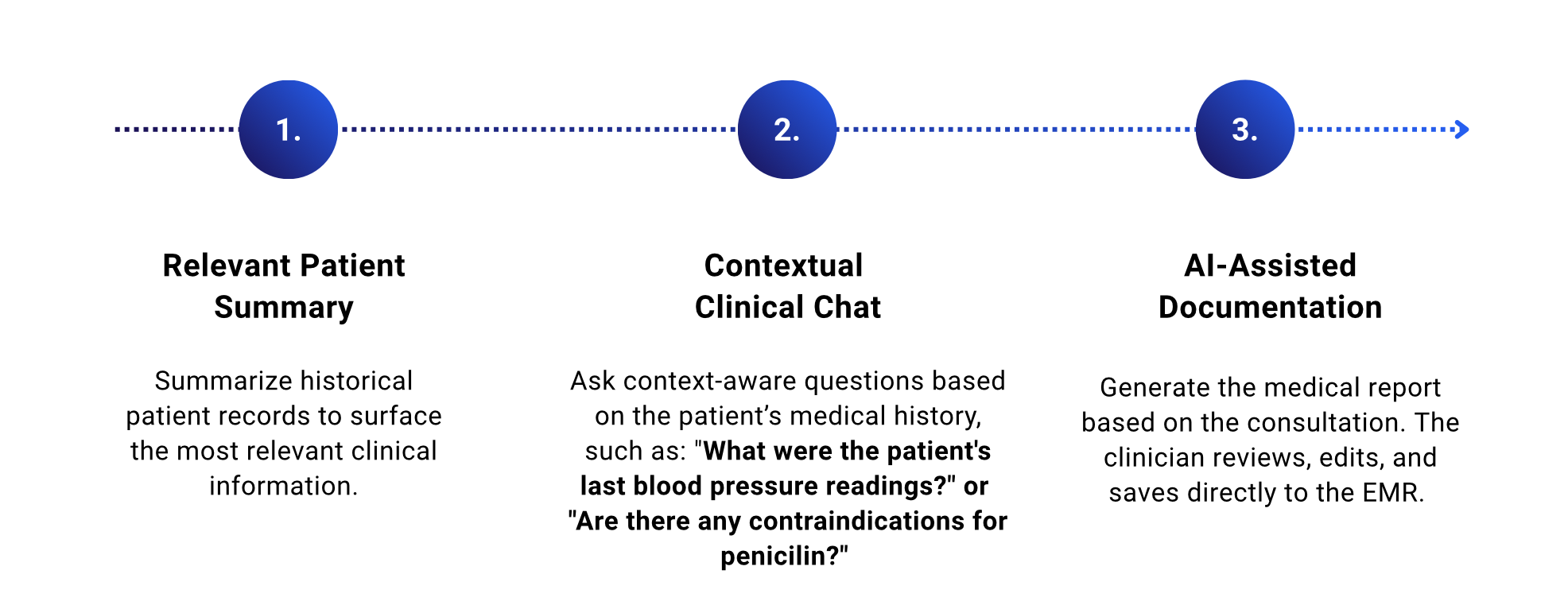
Before a visit, one agent reviews the patient’s history and surfaces the information most relevant to that appointment. During the visit, the clinician can ask questions grounded in the full record, like drug interactions, prior labs, and comorbidities, while other agents listen to the ambient conversation and extract a structured summary from the dialogue. After the visit, another agent drafts the encounter note based on the conversation. The clinician reviews, edits, and signs it, and the final version is written back into the EMR as structured data.
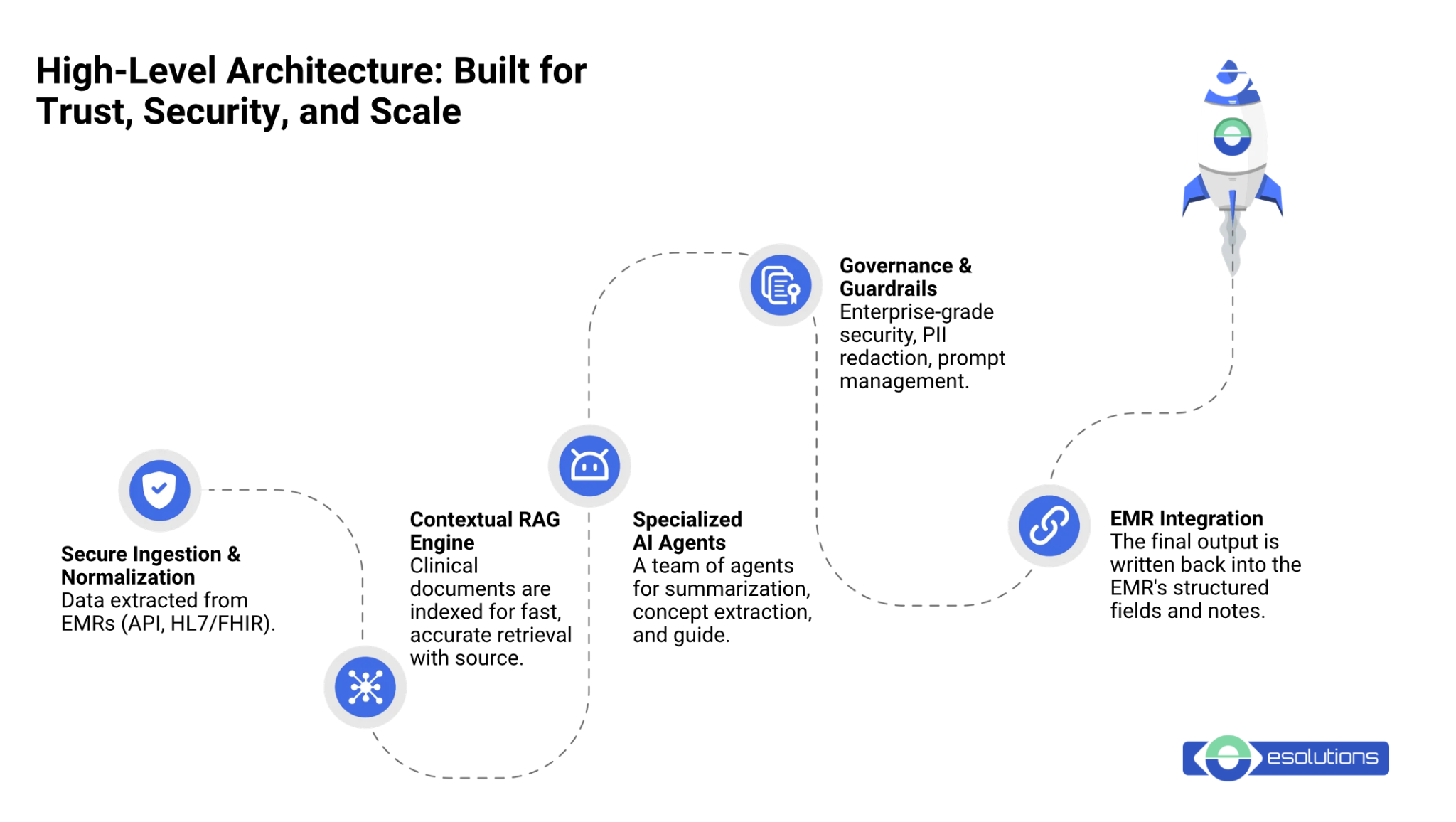
The architecture is simple, data moves through standard HL7/FHIR interfaces, and each agent does one thing: summarize, retrieve with citations, draft, and redact PII. In the next stage, the outputs are validated before they touch the record. Nothing in the stack is novel. What is different is the discipline of keeping each component narrow and auditable in a setting where the cost of an error is measured in patient harm and regulatory exposure.
Most public debate asks what AI can do. The useful question for anyone putting it into core business processes is how to bound what it does and, afterward, prove what it did.
The answer is narrower than the hype suggests but larger than skeptics allow. AI agents that are limited to specific tasks and fully monitored from start to finish will not create the fully autonomous business that marketing often promises. They will take real cost out of operations now, inside an audit trail that regulators are about to require.
The teams that figure this out first build the operational discipline, process mapping, narrow scope, human checkpoints, and logged decisions that any future system will also need.
The practical next step is not to “adopt AI,” but to identify one bounded workflow, map every decision and exception, and instrument it end-to-end. If you want help doing that in an EMR or other regulated process, you can book a workflow assessment with our team here.
 Corina is the Chief Product Officer at eSolutions, where she leads the strategy for B2B digital products, with a strong focus on ALTEUS, the AI platform designed to monitor enterprise AI systems for governance and efficiency. She is also actively involved in IT consultancy and AI adoption initiatives, helping companies implement AI solutions through specialized audits, operational expertise, and practical guidance.
 RO
RO
 EN
EN


